
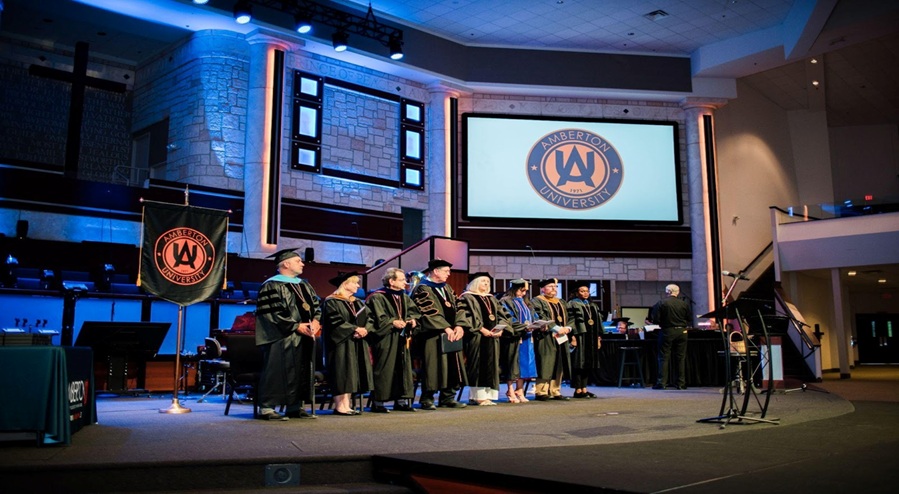
While many universities rely on standardized textbooks, prepackaged curricula, and top-down academic content, Amberton University takes a different path. Professors design their own courses and select their own instructional materials based on course competencies and student learning outcomes assigned to each course.
It’s a model built for working adults and shaped by practitioners. It’s also aligned to the university’s decades-old mission of offering flexible, relevant, and affordable education.
Faculty support this model for one reason. Not because it gives them more freedom, but because it produces better outcomes for the students they serve.
A philosophy built on expertise, not bureaucracy
Amberton hires instructors who actively work in their industries, like project managers, clinical professionals, business executives, psychologists, and consultants. These are not theorists. They’re practitioners shaping the fields they teach in.
That’s why Amberton empowers them to build their own courses from the ground up.
“We have a lot of faculty who work the job they teach,” says Dr. Ron Darnell, Program Director for Amberton’s MBA in Project Management. “Because of that, we can customize assignments, tailor readings, and update content when industry standards change. That flexibility is especially essential in fast-moving fields like project management and technology.”
Instead of departments dictating what book or template every professor must use, Amberton expects instructors to teach what employers expect: current skills, relevant methods, and real-world tools.
No outdated textbooks
Dr. Darnell noted that one of the most common student frustrations in traditional programs is expensive, rarely used textbooks.
Amberton intentionally avoids that problem.
“I keep textbook costs down,” he says. “In most courses, I don’t require a textbook at all. Instead, I ask students to purchase a PMI membership, which is cheaper — and far more valuable.”
A yearly student membership to the Project Management Institute costs about $32 and gives learners access to:
- PMI’s entire digital publication library
- Updated Bodies of Knowledge (PMBOK® Guide)
- Practice standards
- Overviews of emerging trends
- PMI’s new AI-driven learning tool, PMI Infinity
Dr. Darnell puts it this way: “why assign a $200 textbook when students can access everything PMI publishes, including the latest methodologies, for a fraction of that cost?”
This practical approach reflects Amberton’s broader commitment to affordability, one of the university’s Six Pillars of Service Excellence.
Courses that evolve as quickly as the field
Amberton professors write their own courses. They also revise them often.
Content updates reflect shifts in tools, standards, and professional practice.
In Dr. Darnell’s courses, that means practical variation each term.
Students use PMI Infinity to explore project scenarios grounded in real PMI content. Discussion boards focus on issues drawn from student industries, including healthcare, technology, construction, and nonprofit work. Case activities change based on current project challenges.
“No two students have identical experiences,” he explains. “I adjust my curriculum to the students in front of me. That’s only possible when the professor truly owns the course.”
An instructional model built for working adults
Amberton’s students are not recent high-school graduates. They’re working adults, often with full-time jobs, family responsibilities, and community commitments.
Therefore, course flexibility is non-negotiable.
In some courses, due dates, pacing, and participation requirements are set by individual instructors based on course goals and student needs. In many courses, weekly Zoom sessions are recorded so that students who cannot attend can still participate by submitting reflections. And the course load, while rigorous, is structured in manageable weekly increments.
“I’ve walked in their shoes,” Dr. Darnell says. “I was a working adult when I returned to school. I know how hard it is to balance kids, jobs, and coursework. Our curriculum is designed around that reality.”
Because professors design their own courses, they can adjust pacing, reading loads, and project timelines to reflect the demands of adult life. All while maintaining academic rigor.
Industry relevance baked into every assignment
Amberton’s instructional model eliminates “busywork.” Amberton avoids assignments that exist only to fill time. Faculty tie coursework to workplace skills.
Dr. Darnell does not rely on memorization-based exams. Instead, students complete applied project documents.
These include risk analyses, stakeholder communication plans, scope statements, project charters, work breakdown structures, agile plans, and post-project reviews.
The work mirrors what professionals produce on the job.
“If you’re a nurse moving into administration, or an engineer trying to shift into project management, these assignments prepare you for Monday morning,” he says. “That’s why faculty-driven course design is so important.”
Faster adaptation to AI, automation, and emerging tools
Amberton supports responsible AI use in the classroom. Every course taught at Amberton University includes an AI component embedded into the course design. Faculty control allows rapid integration.
Dr. Darnell’s courses now include assignments that teach AI as a brainstorming and analysis tool. Students receive guidance on ethics, citation, and appropriate limits. They also work directly with PMI Infinity using verified project data.
Course policies focus on learning outcomes, not shortcuts. The goal is not to teach students how to use AI to write their papers. The goal is to teach students how to use AI in the same way professionals do, to spark ideas, explore approaches, and work smarter.”
This mirrors Amberton’s larger institutional push to be one of the nation’s first AI-literate campuses, with programs teaching both practical skills and responsible use.
A culture that values faculty judgment and student success
Amberton’s Mission, Vision, and Six Pillars highlight a culture where excellence, professionalism, and initiative guide every decision. Allowing professors to build their own courses is aligned to that philosophy.
“Faculty expertise is the foundation of our academic quality,” says University President Dr. Carol A. Palmer. “When professors are trusted to design what they teach, students receive education that is immediately valuable in their careers.”
Dr. Darnell echoes this sentiment: “Our students’ success, whether in the classroom or in their careers, is central to everything we do. Course design freedom is what allows us to give them the best possible experience.”
The Amberton difference
Many universities still rely on fixed materials and uniform course shells. Amberton prioritizes flexibility, relevance, and faculty accountability.
Professors select their materials. They design assignments. They revise content as industries change.
The goal is not convenience. It is preparation.
For working adults seeking practical, current education, that difference matters.
About Amberton University
Amberton University specializes in flexible, affordable degree programs for working adults, offering fully online and on-campus options, practitioner-led instruction, and career-focused curricula.
