
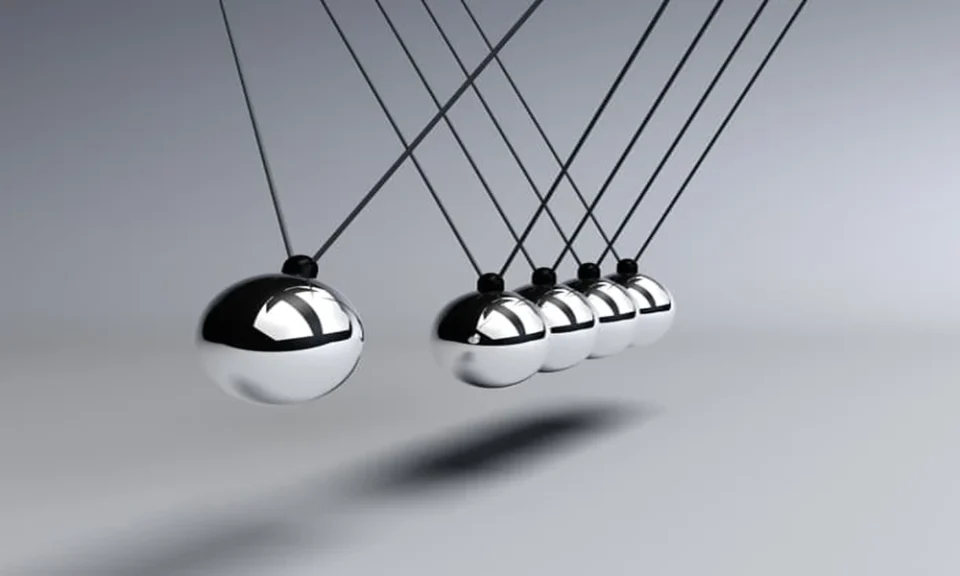
This Newton’s Cradle tool offers a clear, hands-on lesson in classical mechanics and energy transfer. Learners can explore how a pendulum system transfers motion across symmetrical setups, such as 2 In / 2 Out or 3 In / 3 Out, while tracking live telemetry for velocity, mass, and energy conservation. Switching between momentum and kinetic energy views helps students understand the exact mathematical rules governing every impact.
Newton’s cradle provides a clear introduction to the law of conservation of momentum, a central topic in physics and mechanics. Momentum depends on an object’s mass and velocity, and the total momentum of an isolated system stays constant when there is no net external force acting upon it. Although the suspended balls experience forces from gravity and their supports, the short collision interval makes the cradle a useful approximate model for studying momentum transfer.
In a conventional Newton’s cradle, several equally sized steel spheres hang in a straight line. If one end ball is pulled back and released, it collides with the neighbouring balls, and one ball at the opposite end usually swings outward. When two balls are released together, two typically move away from the far side. These familiar patterns are best understood by considering conservation of momentum together with conservation of kinetic energy in nearly elastic collisions.
Students can use the apparatus to ask meaningful questions. Why does a single incoming ball not normally send two outgoing balls away at half its speed? What changes if the balls are unequal in mass or poorly aligned? How would the observed motion differ if the impacts were highly inelastic? Such questions show that conservation laws do not merely describe the experiment after it happens; they help predict which collision outcomes are physically possible.
For classroom demonstrations, the device can be paired with slow-motion video, measurements of release height or simple momentum calculations. Learners develop familiarity with mass, velocity, impulse, force and collision dynamics while testing their own predictions. They can also discuss how the direction of velocity matters because momentum is a vector quantity, not simply a measure of speed. The Newton’s cradle makes conservation of momentum approachable because it offers a repeatable, hands-on example that connects mathematical reasoning with a distinctive and readily observable result.
What makes this educational Newton’s cradle simulator stand out is its ability to compare ideal physics against real-world limits and modern magnetic alternatives such as the Active Magnetic Cradle by Active Kinetic 1. By testing the decay mode, students see how friction and collisions cause gradual energy loss, while the Paradox mode highlights the exact point where kinetic energy equations break down. Learners can even switch modes to see how momentum and kinetic energy transfers throughout collisions.
Newton’s Cradle Simulator
Compare classical mechanical sphere impacts with parallel-face Active Magnetic Cradle (AMC) dipole carriages.
|
Impacts: 0 | Energy Retained: 100.0%
