The cleanest leaf in the pond is rough.
Ask how to make a surface stay clean, and many people will say to make it smooth. The lotus does the opposite. Its leaf is covered in microscopic bumps topped with wax, so water cannot spread out. It beads into drops that roll off, collecting dust as they go. The leaf cleans itself every time it rains.
You do not need a pond to see a similar effect. Drop water on a colocasia leaf, the arbi leaf sold in any Hyderabad vegetable market, and watch it bead and slide away like liquid mercury. The obvious human answer was not necessarily the only answer, and nature had another possibility. That small surprise is where biomimicry begins.
What is biomimicry in education?
The word joins two Greek roots, bios for life and mimesis for imitation. Biomimicry means learning from living things to solve human problems. In a school setting, it means teaching children to look at a leaf, a bird or an insect and ask not only what it is, but how it works and what we could learn from it.
Biomimicry is often associated with university design, but it can begin much earlier. Biomimicry Methodology for K-10: The Blue Blocks Canon Project, a framework published by the school in 2026, proposes that children can begin designing and prototyping from around the age of six, with experiences adapted to their development. Families looking for a biomimicry lab school hyderabad offers can see that framework at work in the school’s Biomimicry Hive.
Before designing, a child must understand the living system. Biophilia, our natural affinity for living things, is what draws children into that closer observation.
How biomimicry inspires design thinking
Design thinking, as it is usually taught, starts with people: understand the user, define the problem, generate ideas, build a prototype and test it. Biomimicry transforms design thinking by adding one crucial question most design classes skip: how has nature already solved this?
This question evolves as children grow. Before the age of six, the senses come first. Young children touch bark, smell flowers and handle soil. They are not expected to design inventions, but they are building a deep store of sensory knowledge.
From six to nine, children often begin by representing nature as they see it. They might weave webs like spiders or fold paper into natural forms. This changes how adults should view a child’s work. Reproducing a bird’s shape can teach a seven-year-old to notice proportion and structure before attempting an original application.
From nine to twelve, they may begin to borrow the underlying strategy instead of the shape. From twelve onward, adolescents can run a fuller design cycle on problems they choose themselves. These are broad stages rather than fixed age rules, and they grow out of the Montessori idea of Cosmic Education, which presents the universe as one connected whole. Any answer to what is biomimicry in education at Blue Blocks rests on that view.
Nature as a design partner: how does biomimicry teach design thinking to students?
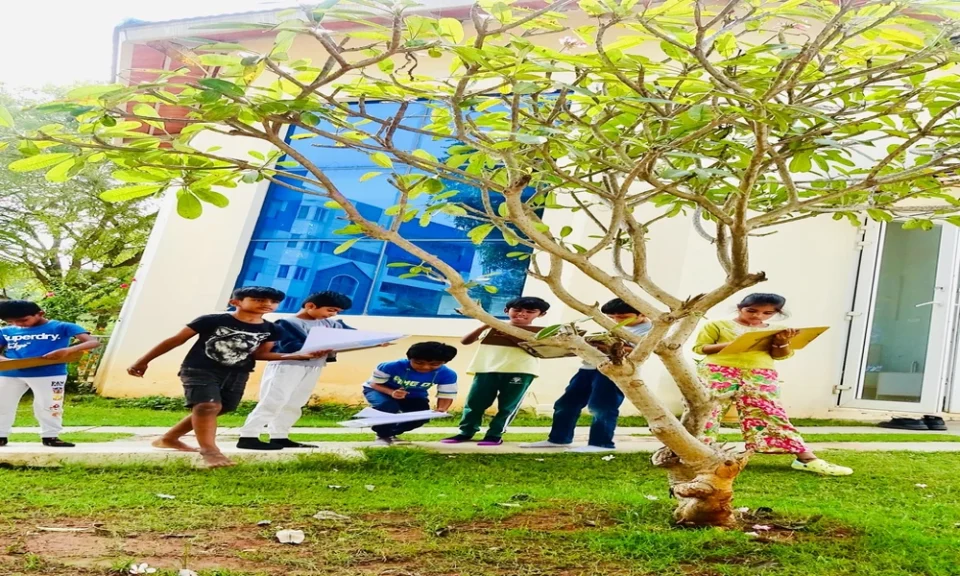
It turns wonder into an investigation. Blue Blocks describes a six-stage journey that moves from nature to observation, then to a question, to research, to a principle and finally to a human application. In the hexagonal Biomimicry Hive, children can connect field observations with sketching, and then with prototyping in the innovation lab school hyderabad families can visit at Tellapur.
Return to the arbi leaf. A classroom investigation might compare how drops behave on different leaves, record what happens over repeated trials and then research why the surfaces differ. Only after that would children ask whether a similar principle might improve a window, a raincoat or another everyday object.
Making something shaped like a leaf is different from learning why it behaves as it does. Biomimicry becomes design thinking when a child moves from appearance to mechanism, and from mechanism to a possible human use.
Nature teaches communication, not only construction
Some of the most interesting biological solutions are not objects at all. Living things coordinate movement, share signals and divide responsibilities.
In a pilot study by the Blue Blocks Micro Research Institute called Becoming Fireflies, 21 children aged nine to twelve developed a shared code using torch flashes and movement paths. In the reported trials, groups correctly decoded 28 of 30 messages, about 93 per cent. Both errors came from confusing the direction of movement-based signals. That is a genuine design discovery: a code must not only be possible to produce, its signals must also be easy for the receiver to tell apart. The study was a small descriptive pilot, without a control group or a long-term assessment.
How biomimicry teaches sustainability
A spider produces silk through biological processes very different from industrial fibre production. A shell grows in water rather than being shaped in a furnace. Comparisons like these help children question the energy, materials and waste behind the objects people make. Nature is not automatically harmless, and imitation alone guarantees nothing.
The school frames this work around three responsibilities: respect, responsibility and regeneration. Sustainability asks how to reduce damage. Regeneration goes further and asks how a design might help living systems recover.
The school’s Seed Bank gives this a tangible form. Children have collected, sun-dried, jarred and catalogued 100 varieties of seeds, recording names, growing seasons, plant lifespans and favourable conditions. The archive helps them see a seed not as an object to store but as part of a cycle of soil, water, seasons and future growth.
When families become researchers
For parents comparing schools, the true test is whether learning moves beyond an attractive display and gives children the time and support to investigate questions of their own.
Through the school’s child-parent research collaboration model, children aged six to twelve and their parents undertake ten to fourteen days of nature observation at home, following the same six stages, from nature to a human application. Parents help children keep the process going and attend to safety, but are asked not to supply the explanation. The child leads.
Instead of telling a child, “That insect is hiding because it is afraid,” a parent might ask, “Where did it go when the light changed?” That question invites another observation rather than an assumed answer.
In the 2026 programme, children and their families carried out nature investigations across five categories: Designs, Behaviours, Rhythms, Movements and Systems, producing more than 70 research papers.
Through the Explore Montessori 2026 initiative, students and their parents have carried out nature studies together. The result is more than 70 child and parent research papers, transforming families into co-researchers. All of this work will be shared publicly at The Biomimicry Park event on 28 November 2026, from 9:00 AM to 12:30 PM at the school’s Tellapur campus. Visitors will be able to follow each project from the first observation to the final working model.
What parents can look for in a biomimicry programme
Attractive displays tell only part of the story. Ask to see a child’s observation journal. Was there a question before the model? Did the child compare observations, research the organism’s actual mechanism and reconsider an early assumption? Can the child explain whom the proposed design might serve and what it might cost the environment?
Frequently asked questions
Is biomimicry science or art?
It is both. Biomimicry requires careful scientific observation and testing to uncover a natural principle, but it also requires imagination and art to turn that principle into something new. It naturally brings physics, chemistry, geography and art together.
Does a school need a dedicated lab to teach biomimicry?
No. A garden, a pond, a magnifying glass and a notebook are enough to begin. A dedicated space helps once investigations move into prototyping and testing, but the habit of looking closely matters far more than the equipment.
Why don’t birds fly into spider webs?
Sometimes birds do encounter spider webs. That makes this a useful question rather than one with a quick answer. A child who wants to find out may need to observe where webs are built, how visible the silk is, and how birds move through those spaces. The question sends children back outdoors to watch, wait, read and test.
How can parents try biomimicry at home?
Choose one living thing nearby, such as a balcony plant or a line of ants, and observe it with your child for a week. Keep a shared notebook of questions and resist answering them. Then ask together whether anything you noticed could solve a small problem at home.
Looking closely enough to be surprised
The value of biomimicry in a school is not teaching children to copy nature’s shapes. It is helping them look closely enough that a rough leaf or a flash of light can overturn their first idea.
