
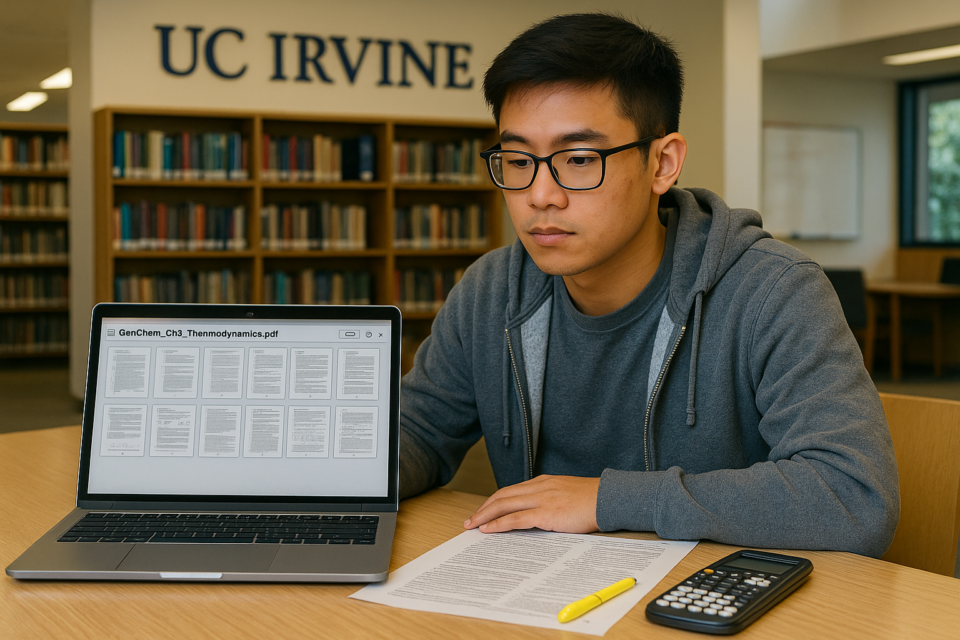
By week four of the quarter at UC Irvine, Kevin Dao was already behind on reading.
It wasn’t for lack of trying. He was a second‑year chemical engineering major, juggling problem sets, lab reports, and a part‑time job at a boba shop on Campus Drive. What finally broke him wasn’t a lab exam or a surprise quiz.
It was a 500‑page general chemistry e‑textbook.
His professor for Chem 1C had stopped using physical books years ago. Instead, the class relied on a single downloadable PDF hosted on the course website—one massive file that contained all chapters, all problem sets, all appendices, all diagrams.
At first, Kevin thought it was convenient. Then he tried to study from it.
When “All in One File” Becomes “I Can’t Find Anything”
The e‑textbook looked clean enough on the surface. But as the quarter went on, its size became a real problem.
Kevin’s study routine went something like this:
- Open the 500‑page PDF
- Scroll… scroll… scroll…
- Try to remember whether Le Châtelier’s principle was around page 120 or page 220
- Overshoot, land in the thermodynamics section
- Scroll back, lose his place again
Every time he switched between lecture notes, homework, and the textbook, the PDF reloaded at a random location. On his older laptop, the file lagged when he zoomed into diagrams. Highlighting text felt sluggish. Searching for a term like “equilibrium” brought up hundreds of hits across the entire book, not just the unit they were on.
Meanwhile, midterms were coming.
The more he tried to use the all‑in‑one file, the more obvious the problem became: the textbook was designed for printing… but he was stuck with it as one unwieldy digital block.
A Study Plan That Needed Smaller Pieces
Sitting in the science library one evening, Kevin opened his planner and wrote what he knew had to happen:
- Week 4–5: finish Acids & Bases
- Week 6–7: Chemical Equilibrium
- Week 8: Thermodynamics & Free Energy
The content was fine; the format wasn’t.
What he really needed was:
- One PDF for each unit
- Something he could open quickly on his tablet or phone
- Files small enough to share with a friend or print a few key pages from
- A way to jump right into “today’s topic” without wading through hundreds of irrelevant pages
The textbook wasn’t going to change. So his strategy had to.
From Overwhelmed to Organized: Kevin’s Late‑Night Experiment
One night after his shift, Kevin sat at his apartment kitchen table with his laptop, half a cup of leftover milk tea, and the 500‑page monster open on his screen. He remembered a PDF site a friend had mentioned earlier in the year and typed:
He uploaded the giant textbook and watched as a grid of tiny page thumbnails began to appear. For the first time, he could see the book as individual pages, not an endless scroll.
He grabbed his syllabus and matched the units:
- Chapter 10–12: Acids & Bases
- Chapter 13–15: Equilibrium
- Chapter 16–18: Thermodynamics
The professor had conveniently listed page ranges on the course site. Kevin used those ranges to create smaller PDFs for each major topic. He exported:
Chem1C_Acids_Bases.pdfChem1C_Equilibrium.pdfChem1C_Thermodynamics.pdf
Each was around 80–100 pages—still dense, but mentally manageable.
He went a step further and carved out micro‑packs for exam review: just the example problems, end‑of‑chapter questions, and key summary pages. Those turned into 15–20 page “exam packs” he could annotate heavily without feeling like he was defacing the entire textbook.
The original 500‑page PDF still lived on his hard drive. But now it was backup, not his primary study tool.
And when he later needed to recombine a few of those smaller packets into a single file for printing or sharing with a classmate, he went back to the same site and used the Merge PDF function to stitch only the relevant sections together.
What Changed in His Day‑to‑Day Studying
Once the mega‑PDF was broken into pieces, Kevin’s routine quietly transformed.
In the mornings, between lectures, he could open just the Acids & Bases file on his phone and review key examples without waiting for a 500‑page document to load. During office hours, he pulled up only the Thermodynamics pack while talking to his TA, so they were literally on the same page.
When midterms approached, he sent his “Exam 1 Review Pack” to two classmates who’d fallen behind. Instead of pointing them to a giant textbook and saying “start here,” he gave them a focused set of pages with the exact problems he thought were most important.
It didn’t make the chemistry easier. But it made the studying feel human.
Instead of facing a wall of 500 pages, he was facing a door he could open and close on purpose.
Why This Matters for Thousands of Students With Digital Textbooks
Kevin’s situation isn’t unique to UC Irvine. All over the U.S., universities are shifting to digital materials:
- Entire textbooks in one PDF
- Multi‑course readers bundled into a single file
- “All chapters, all terms” documents that are convenient to upload but hard to navigate
For professors and publishers, one big file is efficient. For students, especially those studying STEM subjects, it can be overwhelming.
Breaking a textbook into logical units doesn’t just improve convenience—it changes the way the brain approaches the material:
- Smaller files reduce decision fatigue (“Where do I start?”).
- Unit‑based PDFs line up with weekly lecture topics.
- Focused review packets are easier to re‑read multiple times.
In other words, the content stays the same, but the experience of learning it becomes more manageable.
Kevin didn’t become a better chemist overnight because he split a PDF. But he did give himself a clearer path through the chaos of the quarter—and sometimes, that’s the difference between barely surviving a class and actually understanding it.
