
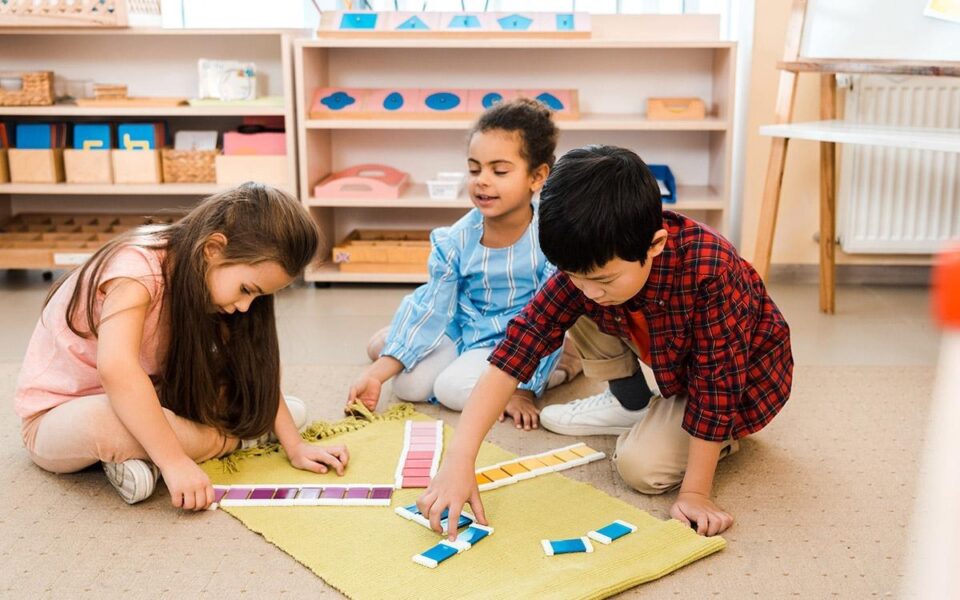
How hands-on experiences build stronger understanding, confidence, and independence in early childhood
In Montessori education, the philosophy of “learning by doing” is more than a teaching strategy — it is a cornerstone of how young children develop cognitive, emotional, and physical skills. Rooted in the scientific observations of Dr. Maria Montessori, the approach recognizes that children learn most effectively when they actively participate in meaningful, hands-on experiences.
At KV Montessori, educators create an environment where children are free to explore materials, make discoveries, and learn through purposeful activity. This article explains why Montessori teachers emphasize hands-on learning and how this approach strengthens the foundation for lifelong academic and personal growth.
“Children learn best not by being told, but by experiencing, touching, exploring, and discovering.”
Hands-On Learning Activates the Whole Brain
Montessori materials are carefully designed to engage a child’s senses. Instead of passively receiving information, children touch, move, sort, pour, count, and manipulate objects.
Why this matters:
• Hands-on exploration stimulates multiple areas of the brain simultaneously.
• Neurodevelopment research shows children remember concepts more deeply when they involve movement and sensory feedback.
• Physical interaction with materials helps children internalize abstract ideas.
In Montessori classrooms, learning is not limited to listening — it becomes a full-bodied experience.
Concrete Experiences Lead to Stronger Understanding
Children build knowledge through concrete experiences long before they can understand abstract ideas. Montessori materials make this possible by introducing real, tactile representations of academic concepts.
Examples include:
• the Pink Tower for size, sequencing, and comparison
• sandpaper letters for letter formation and phonetic sounds
• number rods and bead chains for early math
• practical life exercises for coordination and order
The result:
Children understand why something works, not just that it works. This leads to stronger comprehension and a more confident transition into abstract thinking.
Learning by Doing Builds Independence and Confidence
Every hands-on activity in a Montessori classroom is designed to cultivate independence. Whether a child is pouring water, washing a table, counting beads, or tracing letters, they learn through repetition and self-guided practice.
Long-term benefits:
• children develop perseverance and self-direction
• they gain confidence in their abilities
• they learn to take initiative and solve problems
• they build resilience through trial and error
Children who learn through doing grow into learners who trust themselves — an essential life skill.
Montessori Materials Are Self-Correcting
Another reason Montessori educators emphasize experiential learning is that the materials themselves teach the child. Many activities are self-correcting, meaning the child can identify errors without adult intervention.
For example:
• Knobbed cylinders only fit into the correct spaces.
• Sorting materials visually reveals mistakes.
• Practical life activities show immediate results (e.g., water spills, polishing shines).
Why this is powerful:
Children learn through discovery, not correction. They become comfortable experimenting, analyzing, and refining their work independently.
Movement Enhances Learning and Concentration
Dr. Montessori observed that movement is not separate from learning — it enhances it. Young children need to move to stay engaged, focused, and cognitively alert.
Montessori classrooms incorporate purposeful movement, such as:
• carrying trays
• rolling mats
• walking the line
• transferring objects
• physical coordination exercises
These movements are not distractions — they are part of the lesson.
Benefits of movement-integrated learning:
• improved motor development
• stronger concentration
• better problem-solving abilities
• deeper engagement with academic materials
Hands-on tasks that incorporate movement encourage children to take ownership of their learning process.
Children Develop Real-World Skills From the Beginning
Montessori education prepares children for life by giving them meaningful tasks that mirror real-world activities.
Practical life lessons include:
• pouring water
• folding cloths
• buttoning and zipping
• cleaning surfaces
• preparing food
• caring for plants
These tasks teach coordination and independence, but more importantly, they foster responsibility, order, and confidence.
Why this builds lifelong habits:
Children feel capable.
Children feel trusted.
Children feel proud of their work.
This foundation influences how they approach challenges throughout childhood and beyond.
Learning by Doing Encourages Deep Concentration
Montessori teachers often speak about “flow” — long, uninterrupted work periods where children become completely absorbed in what they are doing. Hands-on activities naturally draw children into this focused state.
Why deep concentration matters:
• it strengthens cognitive development
• it improves self-regulation
• it enhances emotional stability
• it builds patience and persistence
Experiential learning supports these long periods of concentration, helping children develop one of the most valuable academic skills: the ability to focus.
Conclusion
Montessori teachers prioritize “learning by doing” because it aligns with how young children naturally grow, discover, and understand the world. Hands-on experiences activate the senses, strengthen cognitive development, encourage independence, and build skills that last a lifetime.
At KV Montessori, our prepared environment and trained educators create daily opportunities for purposeful, experiential learning — helping every child build confidence, curiosity, and a strong academic foundation.To learn more about Montessori’s hands-on approach, contact KV Montessori or schedule a classroom visit to see “learning by doing” in action.
